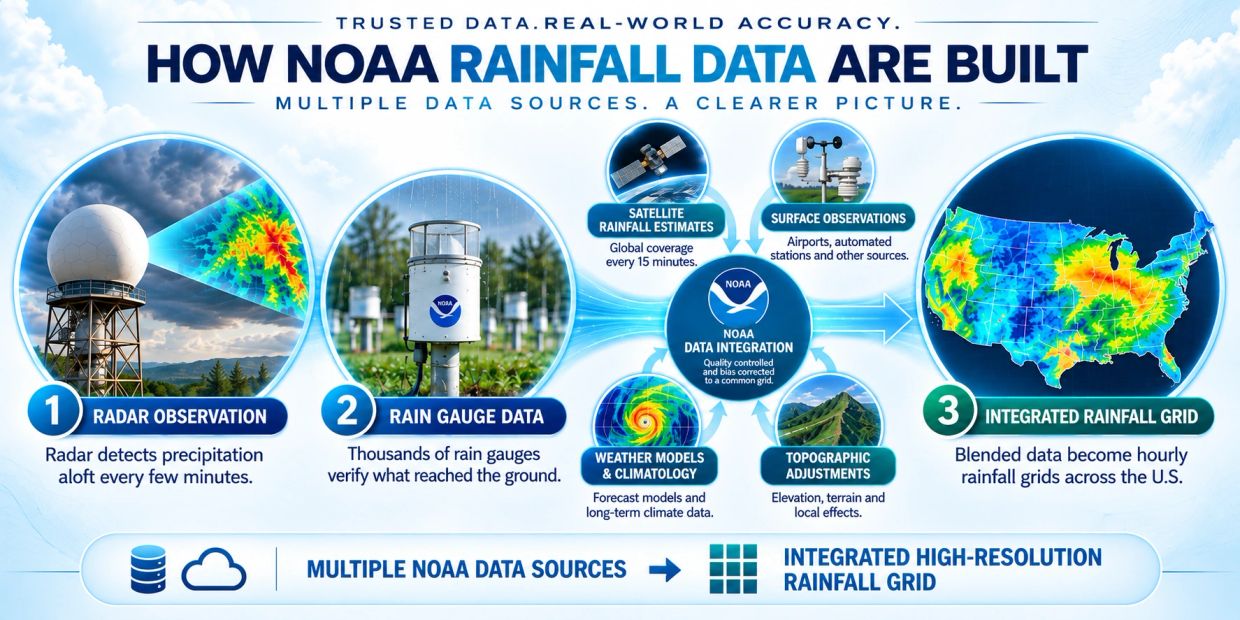
A National System Built From Multiple Data Sources
Each hour, NOAA integrates several complementary data streams
to create a high-resolution (~1 km or 1/2-mile) digital rainfall map:
- Dual-polarization Doppler radar from ~180 overlapping NWS sites
- More than 20,000 rain gauges providing ground-truth measurements
- Satellite rainfall estimates updated every 15 minutes
- Surface observations from airports and automated stations
- Numerical weather models and climatology
- High-resolution topographic adjustments
- Hourly bias correction against regional stations
These inputs work together to generate a precise hourly rainfall grid — a digital rainfall map with millions of evenly
spaced data points, referred to by NOAA as MRMS. This represents actual rainfall reaching the ground.
See more detail here: qpeOnePager.pdf
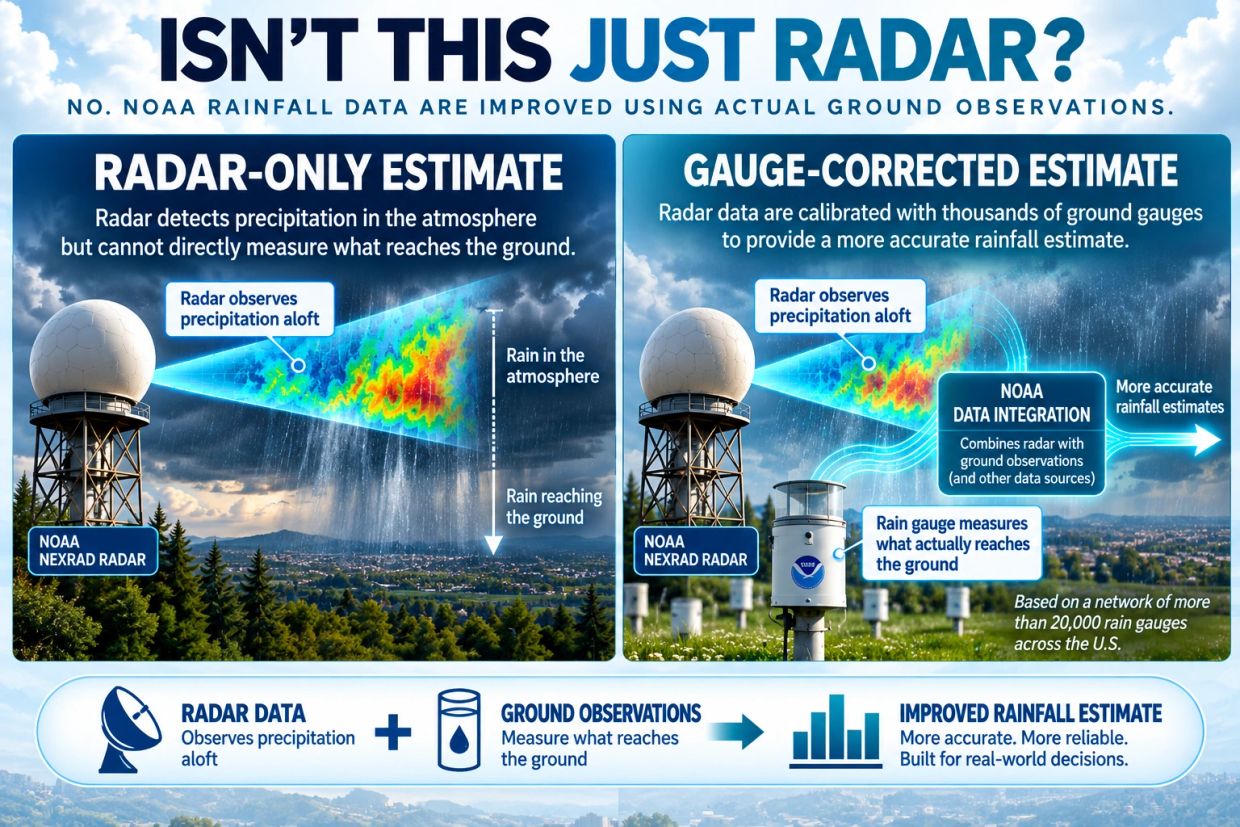
Why Gauge-Adjustment Matters
While radar excels at detecting precipitation aloft, it cannot directly measure what falls at the surface. Because the radar beam sits above the ground, it may overshoot low-level rain or underestimate intensity beneath the beam.
NOAA corrects this automatically by blending in rain-gauge observations and other data inputs each hour. This calibration step adjusts radar-based rainfall up or down and dramatically improves accuracy. The result is a rainfall value that reflects
true ground-level precipitation, not just radar estimates.
Additionally, NOAA scientists periodically improve the calibration process through ongoing research.
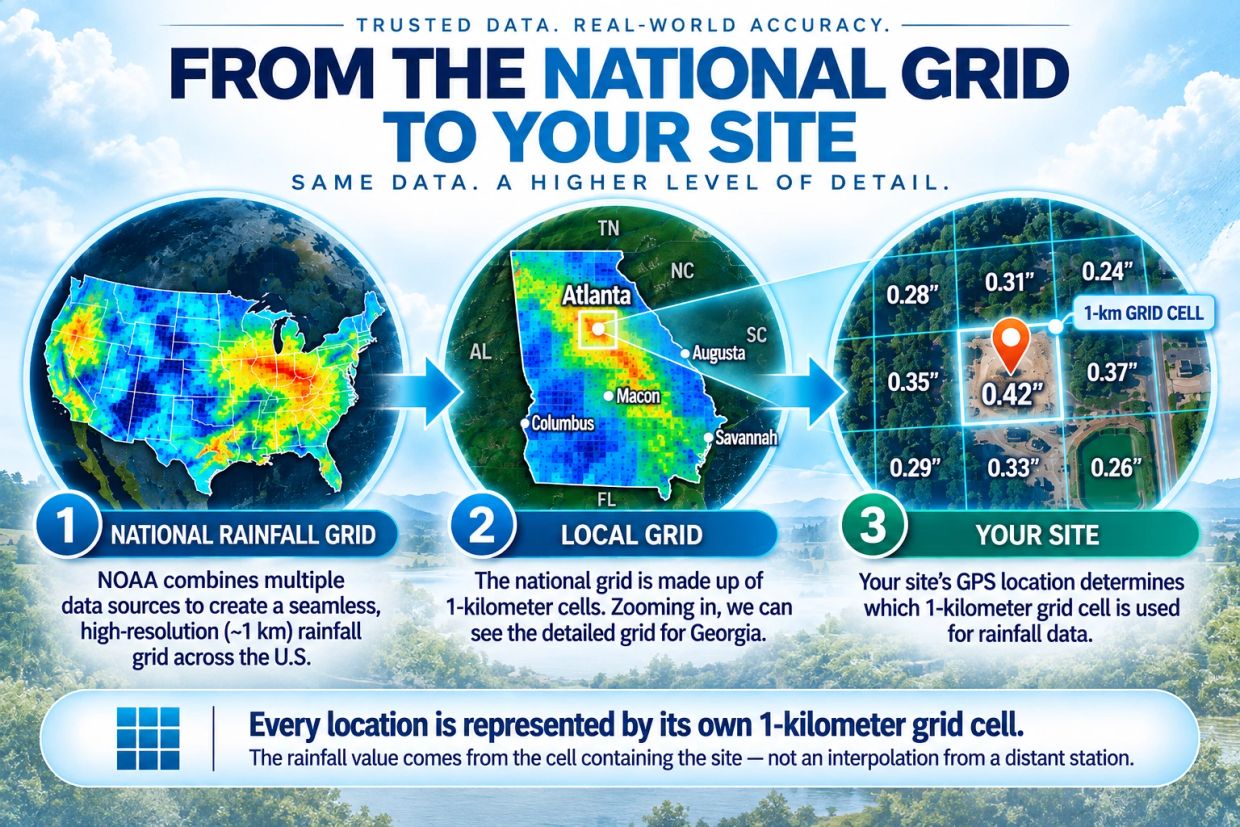
How the Hourly Grid Works
The final NOAA digital rainfall product is a seamless grid where every square—
roughly 1 kilometer (1/2 mile) on each side contains its own hourly rainfall value.
WaterWatch PRO identifies the exact grid cell containing your GPS location and extracts that value directly:
- No interpolation
- No averaging with nearby sensors
- No smoothing or adjustments beyond NOAA's own process
This ensures the rainfall amount you see matches the value NOAA assigns to that precise location in its national dataset.
Comparing NOAA Digital Rainfall Data and A Gauge
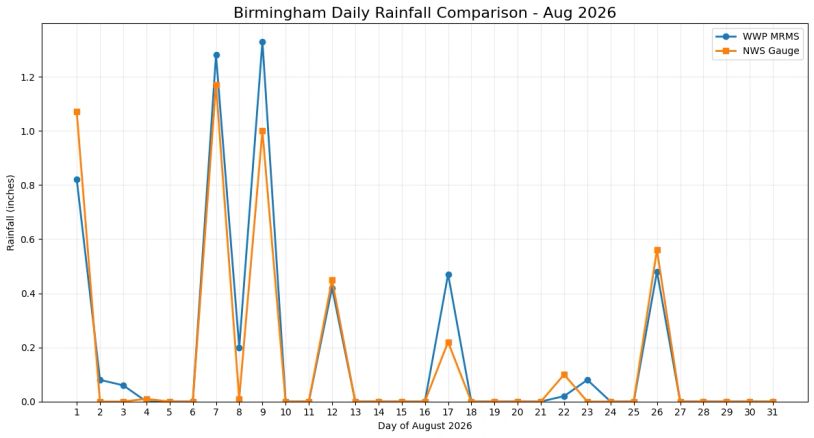
The chart above shows daily rainfall in Birmingham, AL, for June 2026.
The blue line is WaterWatch PRO data, and
the orange line is the airport gauge.
Statistical correlation coefficient of .99
ENVIRONMENTAL FACTORS

When wind flows across the top of a gauge, it creates turbulence and updrafts that deflect raindrops away from the opening. This is especially true when:
- Wind speeds exceed 10–15 mph
- Raindrops are small (as in drizzle or light stratiform rain)
- The mounted gauge is elevated, as is the case for nearly all airports
- Storms occur with frontal passage, when winds increase sharply
Digital NOAA rainfall data is immune to this issue because it is derived from radar reflectivity volumes rather than physical collection.
Microclimate Variability
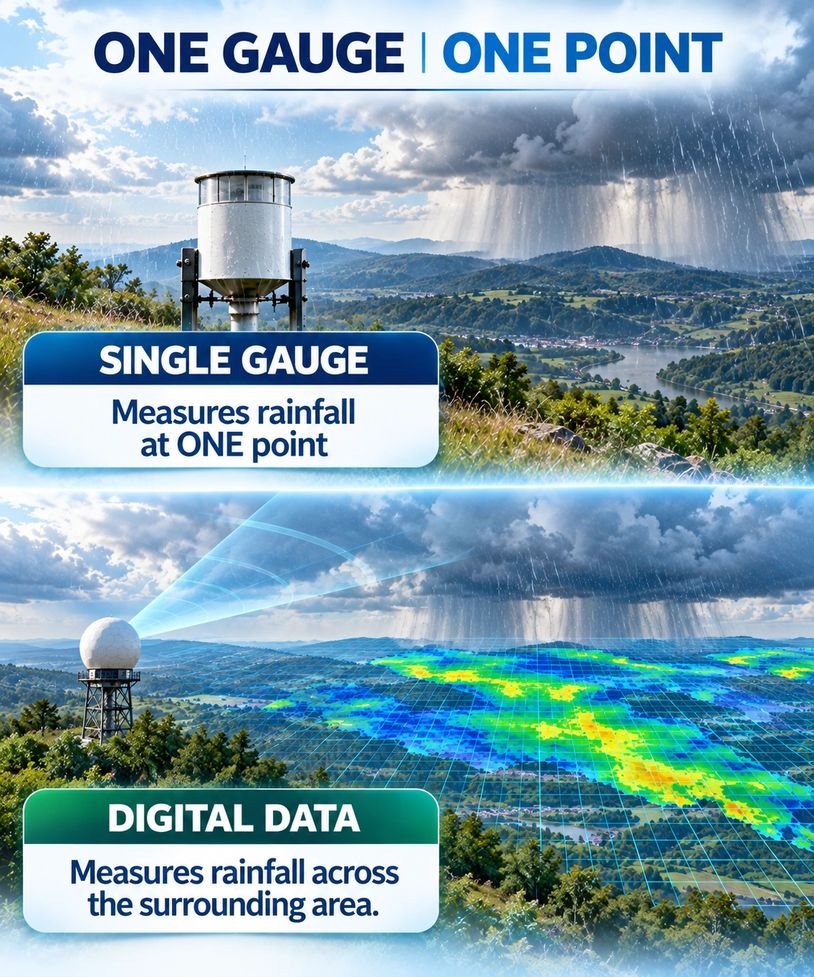
Climatological wind circulations and topography could result in a gauge:
- Sitting under a temporary lull in a shower.
- Lying in a rain shadow depending on storm angle.
- Receiving more or less rainfall than neighboring areas.
Once again, the digital NOAA digital rainfall data integrates radar from all quadrants around the site, smoothing out these micro-scale inconsistencies.
RAIN INTENSITY
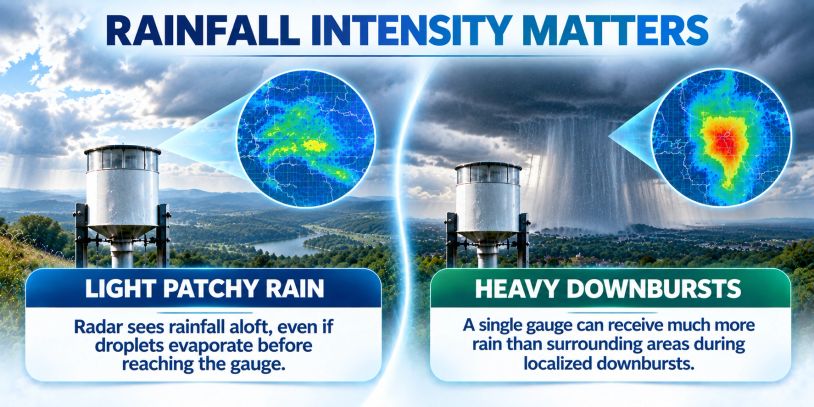
Gauges Have Issues with Light, Patchy Rain
- This is especially likely if the air is dry, winds are strong or warm air is moving into the area.
- Light mist or drizzle can register regionally but miss a single gauge.
- Digital rainfall data integrates radar from all quadrants around the site, smoothing out these micro-scale inconsistencies.
Gauges Have Issues with Heavy Downbursts
- While a heavy burst may pass directly over a gauge, the digital NOAA rainfall data smooths out maximum values.
PHYSICAL LIMITATIONS
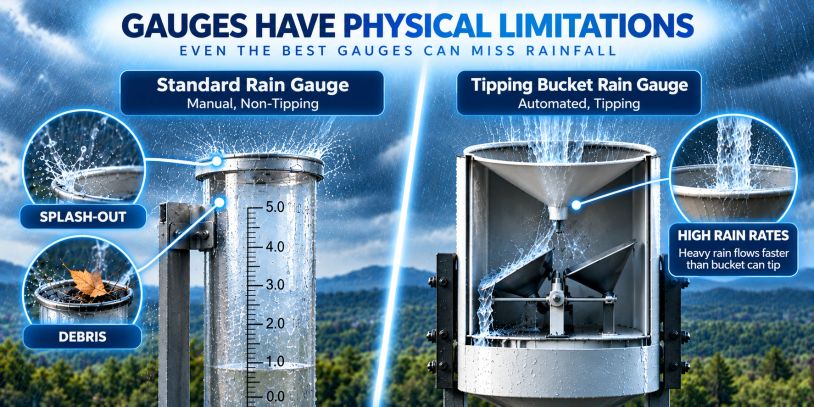
- The standard gauge on the left can under-measure rainfall because debris and water splash outside the gauge during heavy rain events.
- A tipping bucket can also under-measurerainfall during high-intensity storms when rain falls faster than the buckets can tip.